
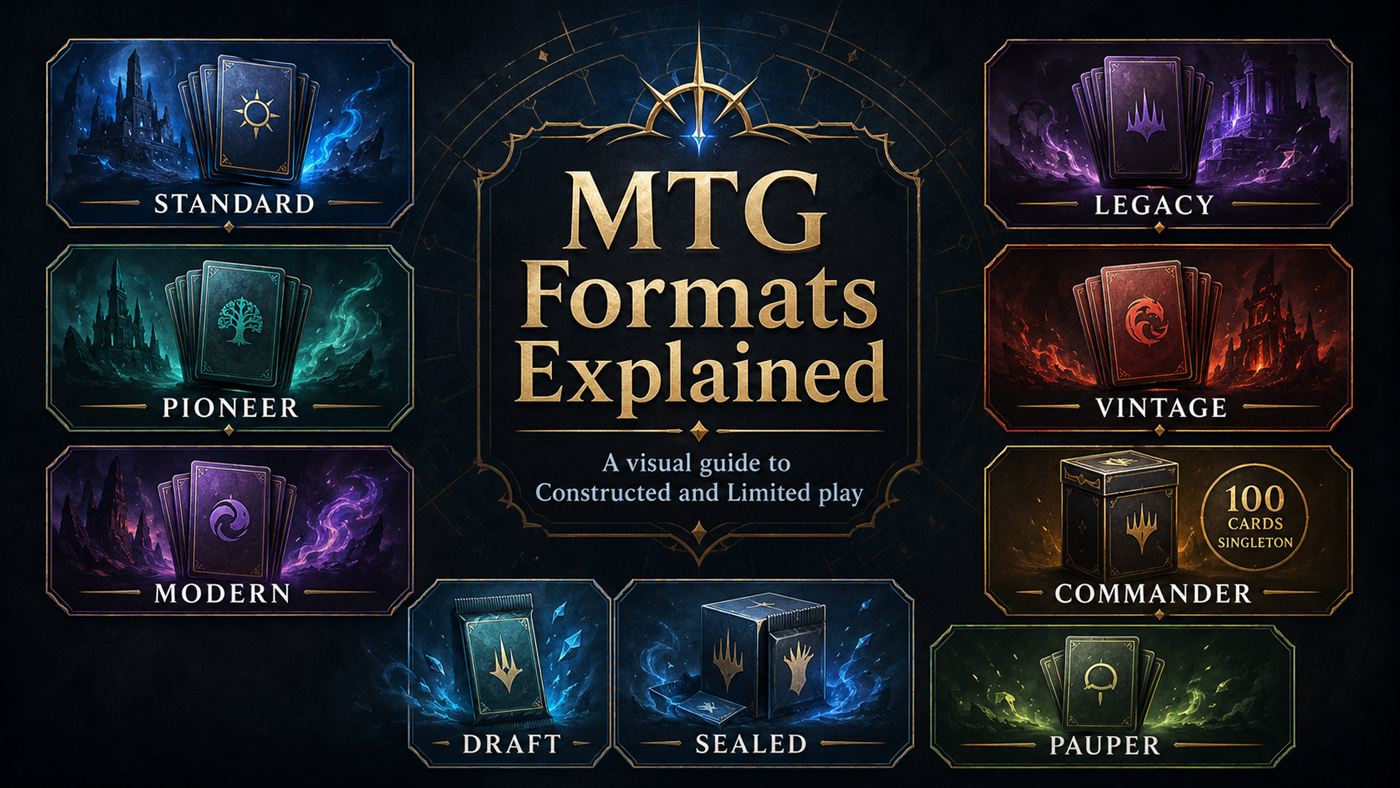
One of the first things that confuses new MTG players is the sheer variety of formats. There is no single way to play Magic — there are fifteen-plus official formats, each with different rules, card pools, and communities. This guide breaks them all down and helps you find the one that fits you best.
Constructed Formats — You Bring Your Own Deck
In Constructed formats you build your deck before the game and bring it with you.
Standard
What it is: The most ‘official’ competitive format. You can only use cards from the last 2-3 years (the most recent 3-5 Wizards sets). Each year a ‘rotation’ happens — older sets rotate out of Standard.
Deck size: 60 cards minimum + 15 sideboard | Players: 2 (1v1) | Life points: 20 each
Why play Standard: No need to buy old expensive cards. Always fresh meta — the game changes with every new set. Official tournaments, Pro Tour, Grand Prix.
Why NOT: Rotation means cards you buy today may leave Standard in 1-2 years. Expensive to keep up with the meta.
Cost for a competitive Standard deck: €150-400 (depending on meta)
In Greece: Played mainly at organised play events at hobby shops. Less casual than Commander.
Pioneer
What it is: An expansion of the Standard card pool — you can use cards from 2012 to today (from the Return to Ravnica set onward). No rotation.
Deck size: 60 cards + 15 sideboard | Players: 2 (1v1)
Why play Pioneer: Massive card pool — many deck-building options. No rotation — your deck does not expire. Less expensive than Modern. Growing scene in Europe and Greece.
Why NOT: Less support from Wizards compared to Standard. Smaller community than Commander or Standard in Greece.
Cost for a competitive Pioneer deck: €100-350
Modern
What it is: Card pool starts from 2003 (8th Edition) with no rotation. One of the most popular competitive formats worldwide.
Deck size: 60 cards + 15 sideboard | Players: 2 (1v1)
Why play Modern: Large card pool with many viable archetypes. Established competitive scene in Europe. Cards you buy remain relevant for years.
Why NOT: Expensive. A top Modern deck can cost €800-2,000+. Requires knowledge of older sets and mechanics.
Cost for a competitive Modern deck: €400-2,000+
In Greece: Played by more experienced players. No large local scene but available online via MTG Arena Digital.
Legacy
What it is: Almost every card in MTG history is legal — from 1993 to today. Exception: cards on the Banned list.
Deck size: 60 cards + 15 sideboard | Players: 2 (1v1)
Why play Legacy: Enormous variety of strategies. The ‘pure’ Magic experience — the most powerful cards ever printed.
Why NOT: Extremely expensive. Reserved List cards (e.g. Dual Lands) cost hundreds of euros each. Almost no local scene in Greece.
Cost for a competitive Legacy deck: €2,000-10,000+
Premodern
What it is: A community-created format started in 2012 by Martin Berlin. Uses cards from Fourth Edition through Scourge (1995-2003) — all cards with the classic old card frame of that era. Bridges the gap between Old School 93/94 and Modern.
Deck size: 60 cards minimum + 15 sideboard | Players: 2 (1v1) | Card pool: ~5,400 unique cards (Portal sets and promos excluded)
Why play Premodern: Play with iconic cards from the golden age of MTG without needing the Power Nine or original Dual Lands — the most expensive cards are not legal. No rotation — the format is eternal, the card pool never changes. You can play with gold-border reprints (World Championship Decks) at many events, making it more accessible. Archetypes and staples remain stable — build a deck and keep it forever. Nostalgic gameplay that echoes how Magic was played in the 2000s.
Why NOT: Community format — no official Wizards support or Pro Tour. Small scene in Greece (exists but is niche). Some cards remain expensive due to the Reserved List.
Cost for a Premodern deck: €100-600 (depending on archetype — much cheaper than Legacy)
Classic Premodern archetypes: Sligh, Suicide Black, Stasis, Oath of Druids, Survival Madness, Goblins, Enchantress — decks long-time players will recognise immediately.
Why Premodern makes sense for players from the Mirage era: If you started MTG in the late 90s or early 2000s, Premodern is essentially the format you carry in your memory. The cards you remember, the mechanics you learned — without the bloat of modern sets and without the prohibitive costs of Legacy.
In Greece: Small but real community, mainly through Facebook groups and online play. If you find other players, it is very worthwhile.
Vintage
What it is: The most open format — all cards legal, with some restricted (maximum 1 copy instead of 4). Includes the Power Nine (Black Lotus, Moxes, etc.).
Why NOT for most players: A competitive Vintage deck can be worth €20,000-50,000+. Played mainly with proxy cards in casual settings.
Commander (EDH)
What it is: The most popular format in Greece and worldwide for casual play. 100 cards (singleton), 4 players, 40 life points, built around one legendary Commander.
Deck size: Exactly 100 cards (1 copy of each card, except Basic Lands) | Players: Usually 4 (multiplayer) | Life points: 40
Why play Commander: The most fun and social format. Enormous variety — hundreds of viable Commanders. You do not need expensive cards to have a great time. You can start with a €50-60 Precon Deck.
Why NOT: Games take a long time (1-3 hours). No official competitive scene (it is casual by nature).
Cost: €50 (Precon) to €500+ (optimised custom build)
cEDH (Competitive Commander)
What it is: Commander at maximum power — players building the strongest possible Commander decks using the best cards in the format.
Cost: €500-2,000+ per deck
In Greece: Very small community — mainly online. If cEDH interests you, start at the r/CompetitiveEDH subreddit and community Discord.
Limited Formats — You Build Your Deck On the Spot
In Limited formats you do not bring your own deck — you build one from cards you open on the day.
Draft (Booster Draft)
What it is: Each player opens a pack, keeps one card, and passes the rest to the left. Repeated for 3 packs. Then you build a 40-card deck from what you picked.
Players: Usually 8 | Cost: 3 Play Booster Packs (~€15-18) + entry fee at organised events
Why Draft: Excellent way to learn a new set. Everyone starts equal — the richest player does not automatically win. Very fun with a group.
In Greece: Prereleases (run by hobby shops) are based on Limited play. If you find a group, you can run casual drafts at home with 2-3 Play Booster Boxes.
Sealed Deck
What it is: Each player opens 6 packs and builds a 40-card deck from those cards only.
Cost: 6 Play Booster Packs (~€30-35) + entry fee
Why Sealed: Less complex than Draft (no need to read what others are picking). The format of prereleases.
Format Comparison — Quick Reference Table
| Format | Card Pool | Players | Entry Cost | Ideal For | Official Link |
|---|---|---|---|---|---|
| Standard | Last 2-3 years | 1v1 | €150-400 | Competitive, new cards | WotC ↗ |
| Pioneer | 2012-today | 1v1 | €100-350 | Competitive, mid budget | WotC ↗ |
| Modern | 2003-today | 1v1 | €400-2,000+ | Competitive, experienced | WotC ↗ |
| Legacy | Almost all | 1v1 | €2,000+ | Enthusiasts, expensive | WotC ↗ |
| Premodern | 1995-2003 | 1v1 | €100-600 | Nostalgia, old school | premodern.com ↗ |
| Vintage | All | 1v1 | €20,000+ | Collectors, proxy | WotC ↗ |
| Commander | Almost all | 4 players | €50-500 | Casual, social | WotC ↗ |
| cEDH | Almost all | 4 players | €500-2,000+ | Competitive Commander | WotC ↗ |
| Draft | New set | 8 players | €15-20/person | Fun, social, fair | WotC ↗ |
| Sealed | New set | 2-8 players | €30-35/person | Prereleases | WotC ↗ |
Which Format Should You Choose?
If you are a new player: Start with a Commander Precon or Draft with friends. Both are fun, accessible, and do not require knowledge of older cards.
If you want competitive play: Standard is the most accessible entry point. Pioneer if you want more options.
If you play with a group of friends: Commander — plain and simple. This is what 80%+ of the Greek community plays.
If you are interested in MTG history: Legacy or Vintage — but prepare your budget.
If you started MTG in the 90s/2000s: Premodern — play with the cards you love in a stable, eternal format without the Power Nine barrier.
Sealed Product You Need for Each Format
| Format | What You Buy |
|---|---|
| Standard / Pioneer / Modern | Singles from CardMarket or Skroutz |
| Commander | Commander Precon Deck (~€55) or singles for a custom build |
| Draft | Play Booster Box (30 packs = ~5 drafts for 6 players) |
| Sealed / Prerelease | 6 Play Booster Packs |
| Warlock Collectibles is a new Greek MTG and TCG store, launching in 2027 with European pricing. We’re currently setting up distributor partnerships ahead of our official launch. Be the first to hear about pre-launch offers and new products: warlockcollectibles.com | info@warlockcollectibles.com |
